
Two Pens, Two Shores
Gentle comeback to the Caspian from the shore of the Mediterranean

August carries the scent of sadness, the month's end approaching, holidays dissolving, the sun and sea season drawing to a close. Yet it is also when the grapes ripen and fall, when they are eaten and collected and made into wine and molasses. This is a story about a wish made to grapes, one that could have had many endings, as many as there are grapestones in the vines.
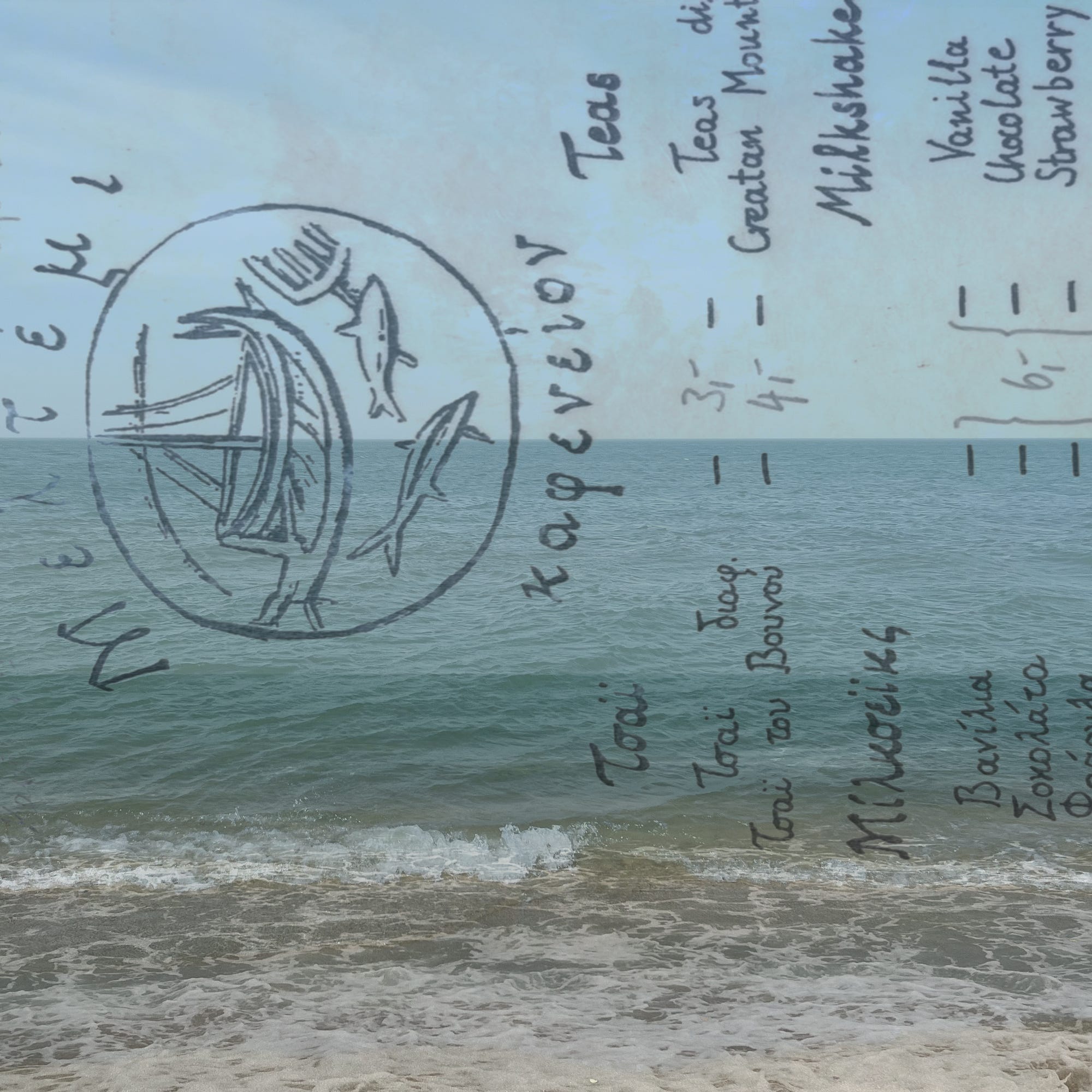
The text below is a dialogue we scribbled inconsistently while sitting at the Mediterranean shore in a cafe called Meltemi, sheltered and protected from the sun by vines and the stone walls of narrow streets. It was a continuation of our conversations about returning to Salt Traces, picking up where we had paused it, roaming far from the shore where we were born and came of age.
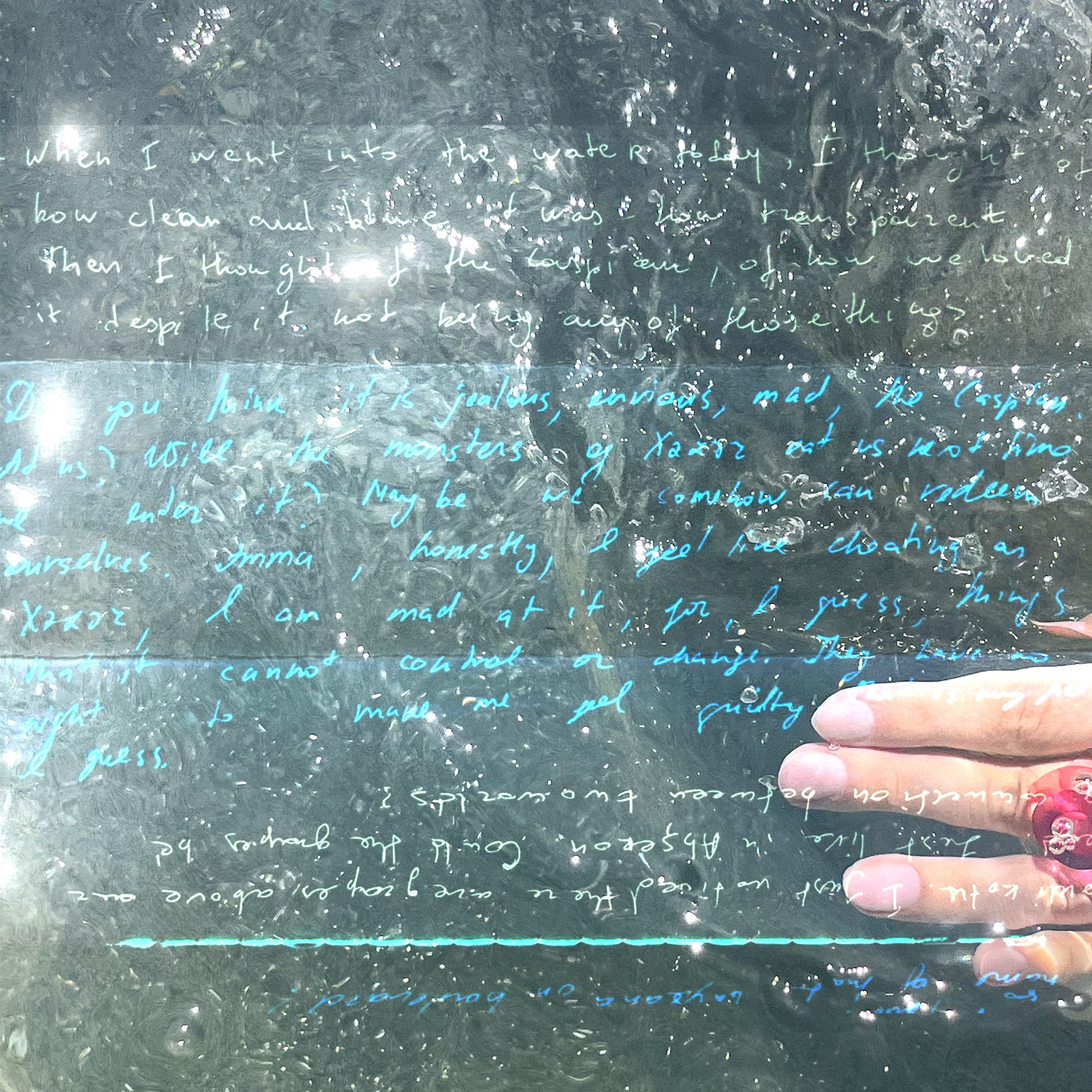
Black pen: When I went into the water today I thought how clean and blue it was — how transparent. Then I thought of the Caspian, of how we love it despite it not being any of those things…
Orange pen: Do you think it is jealous, envy, mad, the Caspian at us? Will the monsters of Xəzər [The Caspian] eat us next time we enter it? If somehow we can redeem ourselves. Honestly, I feel like cheating on Xəzər, I am mad at it for, I guess, things it cannot control or change. They have no right to make me feel guilty. That is my point, I guess.
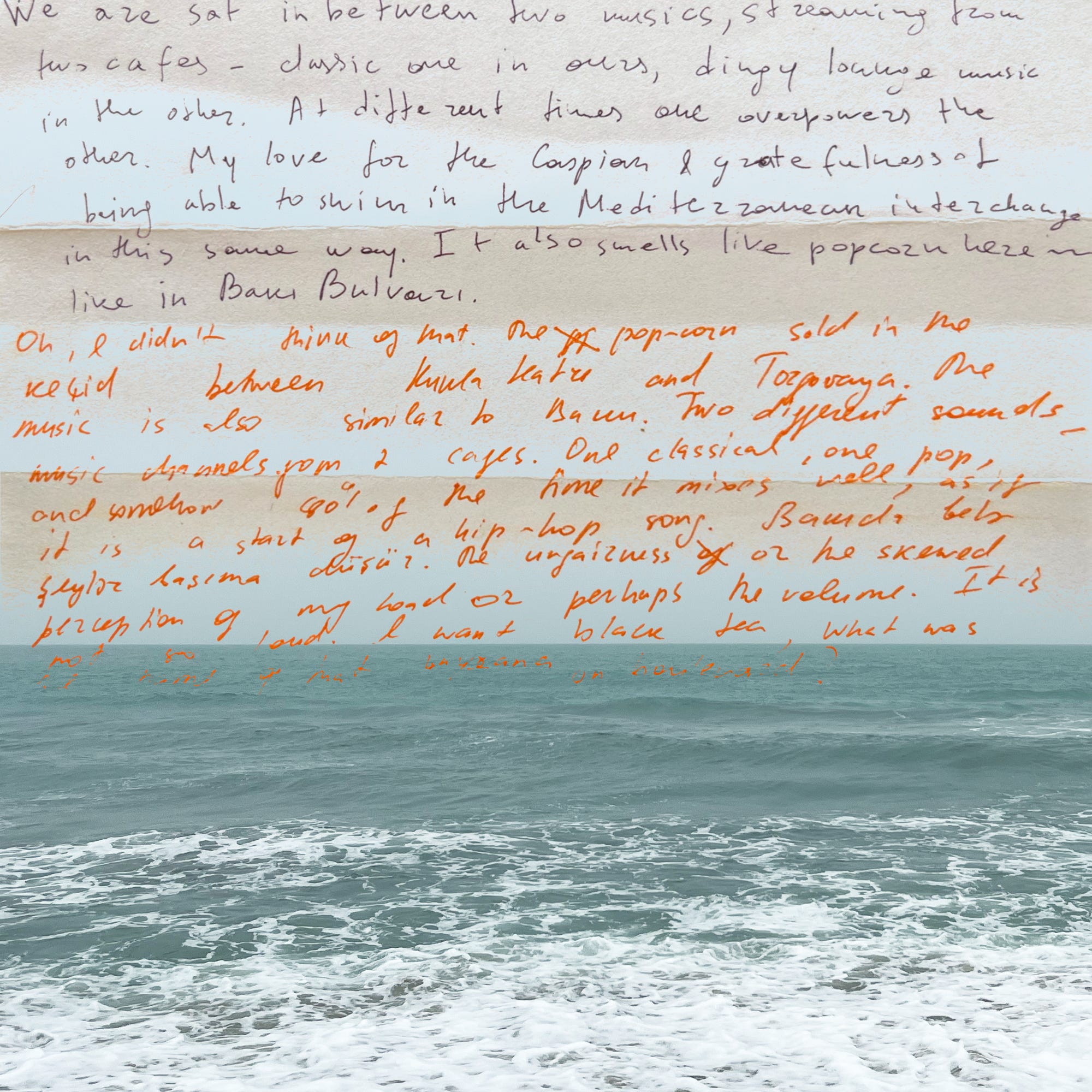
Black pen: We are sat in between two musics, streaming from two cafes — classic one in ours, dingy lounge music in the other. At different times one overpowers the other. My love for the Caspian and gratefulness of being able to swim in the Mediterranean interchange in this same way. It also smells like popcorn here [a wavelike scribble], like in Bakı Bulvarı [Seaside Boulevard].
Orange pen: Oh I didn’t think of that. The pop-corn is sold in the pedestrian underpass between Kukla Teatrı [Puppet Theatre] and Torgovaya [the Nizami street]. The music is also similar to Baku. Two different sounds, music channels from two cafes. One classical, one pop, and somehow 80% of the time it mixes well, as if it were a start of a hip-hop song. Bakıda belə şeylər başıma düşür [These things bother me in Baku]. The unfairness or the skewed perception of my head or perhaps the volume. It is not so loud. I want black tea. What was the name of that Çayxana [Teahouse] on the boulevard?
Black pen reversed: Kəklikotu [Thyme]. I just noticed there are grapes above our heads. Just like in Abşeron [The Absheron Peninsula]. Could the grapes be a connection between two worlds?
Orange pen: Buradan haraya [From here to where] — there was an exhibition like that. “If we ask for tea here they would think we are crazy”, you said. Well, I noticed the grapes before — there is an untidy entangling quality of the vines. I wonder what happens if we pick the grapes. Maybe we will appear in Abşeron.
Minutes after closing the notebook we had pressed our pens into, we asked for the bill. The black pen holder could no longer take the two channel audio track, it didn’t mix in her head as well as it did in the orange pen holder’s imagination. The waiter, who brought the bill, was wearing a grey chequered shirt with his round belly creating a familiar umbrella-like curve and had grey curly hair. His movements and appearance was reminiscent of the images of men stored in our memory, as part of our quotidian on the shores of the Caspian. He might have been one of the uncles cutting a watermelon and giving the top of the fruit cut into quarters to play the game of betting. The rule of this game, often played in summer, is that you hold the four different pieces of the top of a watermelon in your hands, make a wish and throw them backwards. You think of a combination that will land on the floor, and if the pieces land in the combination you predict, your wish will come true.
The man approached us clumsily and put a piece of rolled paper in a small metal bucket on our table. We collected our things and were talking with each other about the evening plans, when he asked us where we were from in a language that sounded like Azerbaijani. We ended up talking in the most comfortable way we can, mixing languages, just like us, he switched from one language to another. He has mentioned being from the shores of the Black Sea, and that he doesn’t feel like he belongs here. He is not a native here and back where he comes from he was not fitting in as an ethnic minority. In the middle of the dialogue he again spoke to us in our mother tongue. So in the most unexpected time and place we have spoken Azerbaijani, as if we were at the Caspian shore. We didn't pick a grape, but perhaps through the ink of our pens a spell was cast, and like many spells, it created a slightly different, unexpected story, choosing from the many grapestones that hang above our heads.
.
.